Introduction to Nutrient Cycles
What you need to know (based on the AQA specification)
What you need to know (based on the AQA specification)
Nutrients are recycled within natural ecosystems, exemplified by the nitrogen cycle and the phosphorus cycle.
Energy travels in an ecosystem in one direction. It goes from the sun and is transferred down the different trophic levels as we saw in Energy and Ecosystems
Unlike the one directional flow of energy through an ecosystem, nutrients are recycled. The nitrogen and phosphorus cycles are examples of nutrient cycles.
Human activity can interfere with this recycling of nutrients, disrupting the natural cycling of these nutrients. We look at this later with fertilisers & eutrophication.
Nitrogen Cycle
What you need to know (based on the AQA specification)
What you need to know (based on the AQA specification)
Microorganisms play a vital role in recycling chemical elements such as phosphorus and nitrogen.
- The role of saprobionts in decomposition.
- The role of mycorrhizae in facilitating the uptake of water and inorganic ions by plants.
- The role of bacteria in the nitrogen cycle in sufficient detail to illustrate the processes of saprobiotic nutrition, ammonification, nitrification, nitrogen fixation and denitrification.
(The names of individual species of bacteria are not required).
All living organisms need a source of nitrogen in order to synthesise nitrogen-containing compounds, such as DNA, RNA, proteins and chlorophyll.
The atmosphere contains 78% nitrogen, but it’s in a chemically inert (unreactive) form that is unavailable to plants or animals to use. They need bacteria to convert it into nitrogen-containing compounds first.
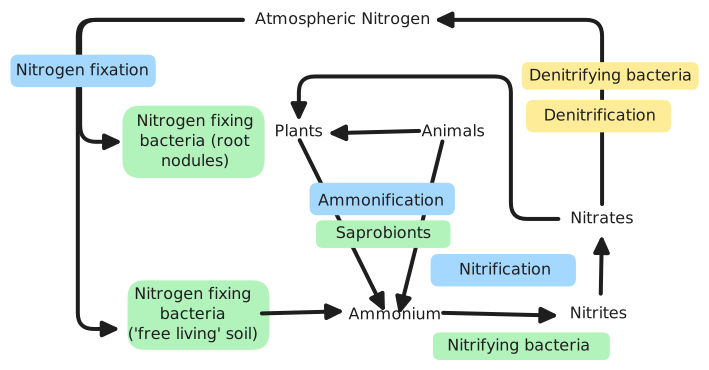
The nitrogen cycle is the continuous recycling of nitrogen between the atmosphere, soil and living organisms.
There are 4 main phases:
- Ammonification
- Nitrification
- Nitrogen fixation
- Denitrification
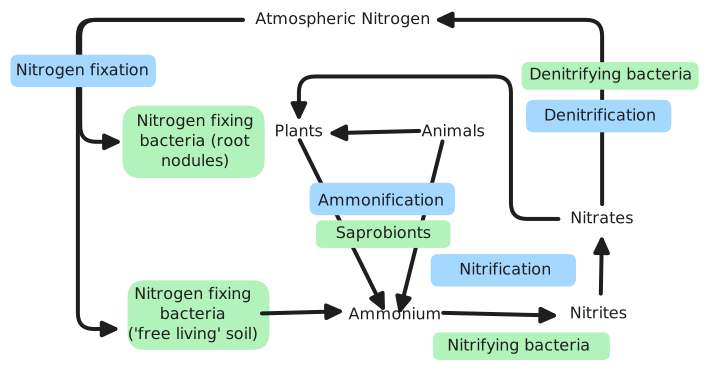
Nitrogen fixation
- Is the process of converting nitrogen gas (which is unusable for plants) into ammonia (NH₃), which forms ammonium ions (NH₄⁺)
- It is mainly carried out by microorganisms, although it can occur from lightning or in industrial processes
- Nitrogen-fixing bacteria are found in plants’ root nodules. They form a mutualistic relationship with plants. The bacteria provide the plant with nitrogen compounds, and the plant provides the bacteria with carbohydrates (required for respiration)
- Nitrogen-fixing bacteria can also be found ‘free living’ in the soil. These do not require a host plant to fix nitrogen
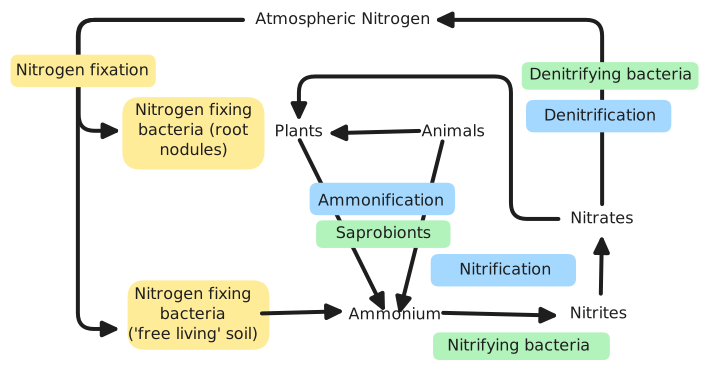
Ammonification
- The nitrogen compounds from dead organisms & animal waste are turned into ammonia by saprobiontic microorganisms
- This ammonia then forms ammonium ions
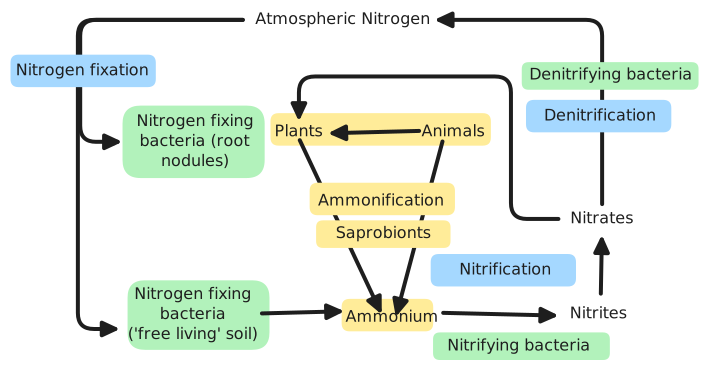
How do saprobiontic microorganisms decompose these dead organisms?
These saprobiontic microorganisms use extracellular digestion - they secrete enzymes which allow them to digest complex molecules into simpler, absorbable forms.
Nitrification
-
This involves the conversion of ammonium ions into nitrate ions
-
This is a two-stage oxidation reaction, which releases energy
-
1 - Nitrifying bacteria carry out the oxidation of ammonium ions (NH₄⁺) to nitrite ions (NO₂⁻)
-
2 - Nitrifying bacteria carry out the further oxidation of nitrites (NO₂⁻) to nitrates (NO₃⁻)
-
-
Nitrifying bacteria require oxygen to carry out these reactions.
-
These nitrates can then be used by the plants. They can assimilate the nitrates by absorbing them and converting them into organic nitrogen compounds like amino acids and proteins.
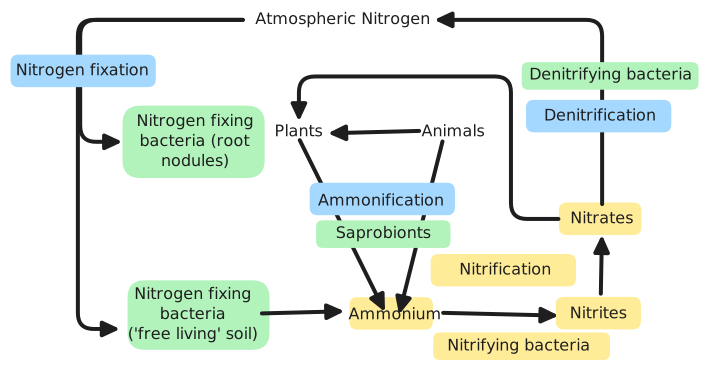
Denitrification
- The nitrates in the soil are converted into nitrogen gas by denitrifying bacteria
- These denitrifying bacteria work in anaerobic (low oxygen) conditions, often when the soil becomes waterlogged.
Tip
It’s important to understand the different conditions both bacteria work in: nitrifying bacteria = aerobic and denitrifying bacteria = anaerobic
Phosphorus Cycle
Phosphorus is required for ATP, phospholipids and nucleic acids (DNA and RNA).
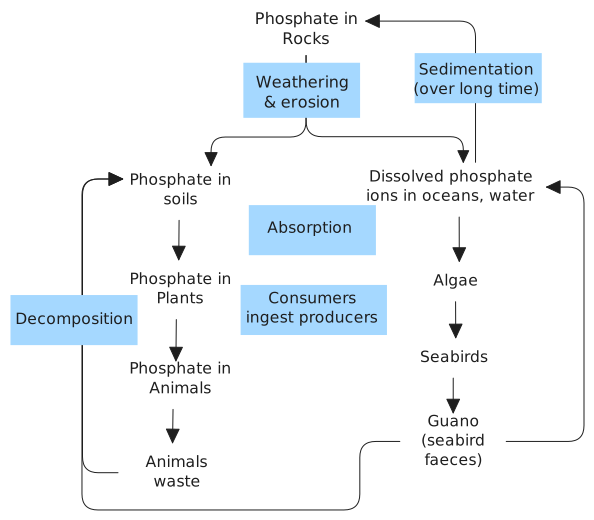
Unlike the nitrogen cycle, phosphorus doesn’t enter the atmosphere. Rocks and sediments are the largest reservoir of phosphorus, usually in the form of phosphate ions.
-
Weathering & erosion - Phosphate ions become dissolved and available for absorption by plants which they can incorporate into their biomass
-
Absorption (Mycorrhizae) - Fungi that form a mutualistic relationship with plant roots. The fungi have hyphae that can increase the surface area of the plant’s roots for the absorption of water and minerals (ions). The fungi (in return as it’s a mutualistic relationship) get glucose and other organic compounds from the plant, which they can use in respiration
-
Consumers ingest producers - Phosphate ions are transferred to consumers as they ingest the plants
-
Decomposition - Decomposers (saprobionts) break down dead animals and plants, releasing phosphate ions into the soil. These microorganisms also release phosphate from animal wastes.
-
Sedimentation. When these organisms die, their remains sink and accumulate as sediments on the ocean floor. Over millions of years, these sediments form sedimentary rock.
Microorganisms’ Role
| Microorganism | Cycle (Stage) | Role |
|---|---|---|
| Saprobiontic microorganisms | Nitrogen (Ammonification) & Phosphorus | Decomposers. Use enzymes to decompose dead organisms and waste, releasing ammonia (ammonification) and phosphate ions (use extracellular digestion) |
| Nitrogen-fixing bacteria | Nitrogen (Nitrogen-fixation) | Convert atmospheric nitrogen gas into nitrogen compounds usable by plants |
| Nitrifying bacteria | Nitrogen (Nitrification) | Oxidise ammonium ions to nitrites, then nitrites to nitrates |
| Denitrifying bacteria | Nitrogen (Denitrification) | Convert nitrates back into nitrogen gas (in anaerobic conditions) |
| Mycorrhizae (fungi) | Phosphorus | Increase surface area of plant roots for absorption of water and phosphate ions |
Fertilisers & Eutrophication
What you need to know (based on the AQA specification)
What you need to know (based on the AQA specification)
The use of natural and artificial fertilisers to replace the nitrates and phosphates lost by harvesting plants and removing livestock.
The environmental issues arising from the use of fertilisers including leaching and eutrophication.
When crops are harvested they are removed from the soil. This means that the mineral (nitrates and phosphates) the crops absorbed from the soil are also removed. They are not recycled back into the soil by decomposers as part of the nitrogen and phosphorus cycle.
Why could this be an issue?
Why could this be an issue?
Soil needs minerals in order for new crops to grow.
- Phosphates are important for ATP production
- Nitrates are important for plant growth (synthesising amino acids & proteins)
Farmers use fertilisers to replace these lost nutrients.
- Natural fertilisers - organic matter such as manure or compost. These release minerals slowly as they are decomposed by saprobiontic microorganisms
- Artificial fertilisers - manufactured chemicals containing specific ratios of minerals (e.g. NPK fertilisers). These dissolve quickly and are immediately available to plants
Leaching
- When excess fertiliser (particularly nitrates) dissolves in rainwater and is washed through the soil into waterways such as rivers and lakes
- Nitrates are very soluble, making them especially prone to leaching (more than phosphate ions)
Eutrophication
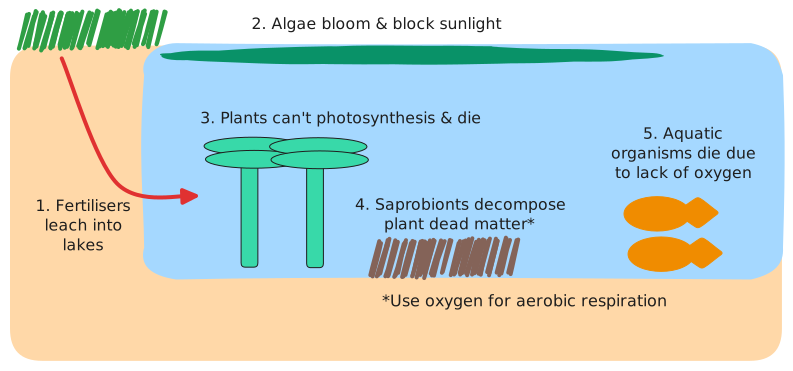
Eutrophication is the process by which excess minerals (from leached fertilisers) cause environmental damage.
-
Fertilisers leach into rivers/lakes, increasing the concentration of nitrates and phosphates in these rivers/lakes
-
This causes rapid growth of algae on the water surface (algal bloom). The algal bloom blocks light from reaching aquatic plants below the surface
-
These plants die as they can no longer photosynthesise
-
Saprobiontic microorganisms decompose the dead plant matter. These decomposers use oxygen for aerobic respiration
-
This causes the oxygen concentration in the water to decrease. Organisms that rely on aerobic respiration (e.g. fish) die due to lack of oxygen
Exam Questions
Describe the role of saprobionts in the nitrogen cycle.
(2 marks)Hint
Think about what saprobionts do to dead organisms and waste — and what nitrogen-containing product is released.
Mark Scheme
- (They use enzymes to) decompose proteins/DNA/RNA/urea (1 mark)
- Producing/releasing ammonia/ammonium compounds/ammonium ions (1 mark)
Tips from examiner reports
- Name specific nitrogen-containing compounds (e.g. ammonia, ammonium ions, nitrites, nitrates — not just ‘nitrogen compounds’)
- Do not describe the whole nitrogen cycle — answer only the part asked about saprobionts
Describe and explain how an increase in mineral ions in a lake can lead to the death of fish.
(4 marks)Hint
Think about the chain of events: what grows first, what dies, what uses up the oxygen?
Mark Scheme
- (Growth/increase of) algae/surface plants/algal bloom blocks light (1 mark)
- Reduced/no photosynthesis so (submerged) plants die (1 mark)
- Saprobiotic (microorganisms) aerobically respire / use oxygen in respiration (1 mark)
- Less oxygen for fish to respire (1 mark)
Tips from examiner reports
- Follow the full chain: excess nutrients → algal bloom → less light → submerged plants die → decomposers use oxygen → less oxygen for fish → fish die
- Mention photosynthesis (plants can’t photosynthesise without light) and respiration (fish and decomposers need oxygen)
- Decomposers are saprobionts — use specific terminology
Freshwater marsh soils are normally waterlogged. This creates anaerobic conditions.
Use your knowledge of the nitrogen cycle to suggest why these soils contain relatively high concentrations of ammonium compounds and low concentrations of nitrite ions and nitrate ions.
(2 marks)Hint
Think about which stages of the nitrogen cycle need oxygen — and which thrive without it.
Mark Scheme
- Less nitrification / fewer nitrifying bacteria / nitrification requires oxygen/aerobic conditions (1 mark)
- (Less) oxidation/conversion of ammonium ions to nitrite ions and to nitrate ions (1 mark)
- More denitrification / more denitrifying bacteria / denitrification requires anaerobic conditions (1 mark)
- (So more) nitrate ions reduced/converted to nitrogen gas (1 mark)
Tips from examiner reports
- Know the nitrogen cycle: ammonification → nitrification (NH₄⁺ → NO₂⁻ → NO₃⁻) → uptake by plants
- Don’t say saprobionts are anaerobic (most are aerobic)
- Denitrification produces N₂ — not ammonia